Location
- Native Range: Originally native to India and Nepal.
- Introduced Range: They were first introduced to the Patio Ranch in the Texas Hill Country and subsequently to other private properties.
- Current Distribution: In their introduced environments, they are primarily found on private properties. While their populations are considered secure in these areas, the species has not significantly flourished.
Description
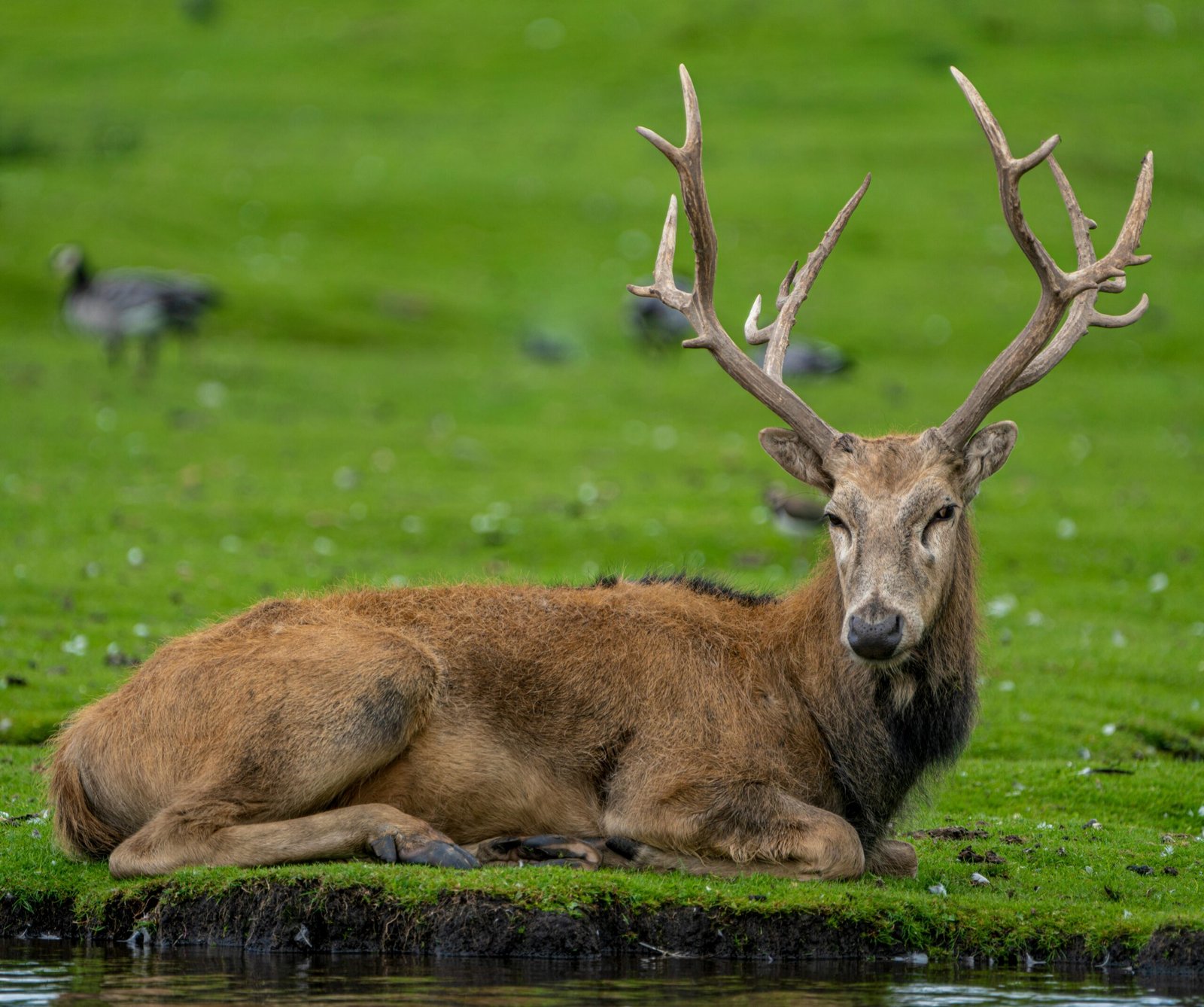
The Barasingha, a name derived from the Hindustani word for “12-tined,” is a large and graceful deer with a stout build.
- Size: Males typically reach a shoulder height of 44–46 inches and weigh between 350–400 pounds, though they can occasionally weigh much more. Females are smaller.
- Coat: The appearance changes seasonally:
- Summer: A rich golden-brown with a darker line along the back.
- Winter: A dull grayish-brown with a coarse texture and lighter underparts. Males grow a prominent neck ruff during this season.
- Antlers: The smooth, flattened beams lack bez or trez tines but feature long brow tines. A set usually has 10–15 points. Configurations vary, often branching twice after a long gap from the brow tine, or occasionally resembling the curved antlers of an Eld’s deer.
Remarks
- Terminology: Also known as the Swamp Deer, though this is partly a misnomer as two of its three subspecies live on hard, dry ground rather than marshes.
- Hybridization: In game environments, the Barasingha is known or believed to crossbreed or exist as a result of hybridization.
- Adaptation: While one subspecies has adapted specifically to marshy habitats, others are native to hard-ground environments.