Location
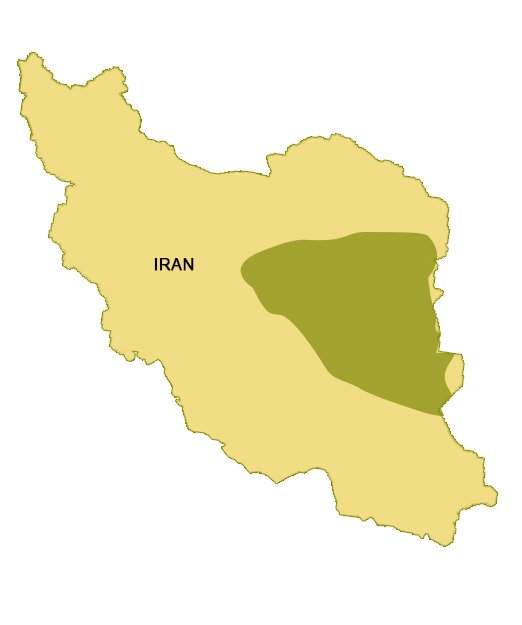
Iran; North, Razavi and South Khorasan Provinces, Yazd, Kerman, Sistan and Baluchesten
Pakistan; Baluchistan Province along the Iranian border
Description
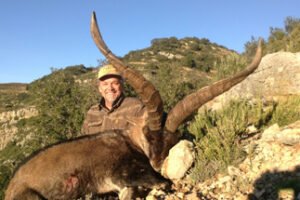
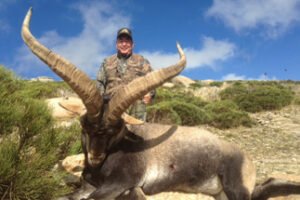
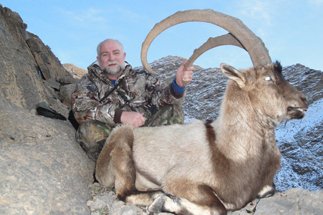
The Persian desert ibex weighs only 100-130 pounds, versus the bezoar ibex which weighs around 200 pounds.. A handsome animal with blackish markings that contrast sharply with the lighter body color. The summer coat is reddish-brown, with adult males turning ashy-gray in winter. Underparts and back of legs are white. The blackish areas include the dorsal stripe, shoulder stripes, flank stripes, front of legs, chest, tail, throat and face. There is a long, black chin beard. Callouses are developed on the knees and sometimes on the chest. Males are characterized by large, scimitar-shaped, laterally compressed horns. The front edge is sharp, forming a keel for some distance, above which are a number of bold, sharp-edged, widely separated knobs.
Remarks
Sedentary, living its life in a small area. Favors steep, rocky terrain, in arid regions. May be diurnal or nocturnal, depending on predator and human activity, but older males tend to sleep in hiding places (often caves) by day and feed at night. Drinks water regularly when available, usually very early or late, or even after dark. Some observers believe it can exist indefinitely without drinking free water. Extremely surefooted and agile. All senses are acute.
Summary:
In Pakistan, Persian desert ibex(Capra aegagrus) are exclusively found within ~50–100 km of the Iranian border, in the extreme southwestern corner of Balochistan, primarily west of the Kech River and within the western Makran and Siahan Ranges, where they inhabit arid, rocky foothills and mountainous desert terrain continuous with southeastern Iran’s Sistan and Baluchestan Province. Their range is geographically isolated from the Sindh ibex by the Central Makran Range and the Kech River basin, establishing a clear natural boundary between the two subspecies.
UPDATE: Currently, there are no legal permits available for the Persian Desert Ibex in Pakistan within the areas recognized by GSCO. The westernmost available permits are located in the Talooband Game Reserve, where the ibex are classified by GSCO as Sindh Ibex. As a result, GSCO currently does not accept Persian Desert Ibex from Pakistan toward its Capra Milestones.
In the United States, a population of Persian ibex was introduced to the Florida Mountains of New Mexico in the 1970s as a game species. This area, near Deming, offers a similarly rocky and arid habitat to their native range. Today, the Florida Mountains remain the only location in North America where a free-ranging population of Persian ibex exists, managed by the New Mexico Department of Game and Fish (NMDGF).