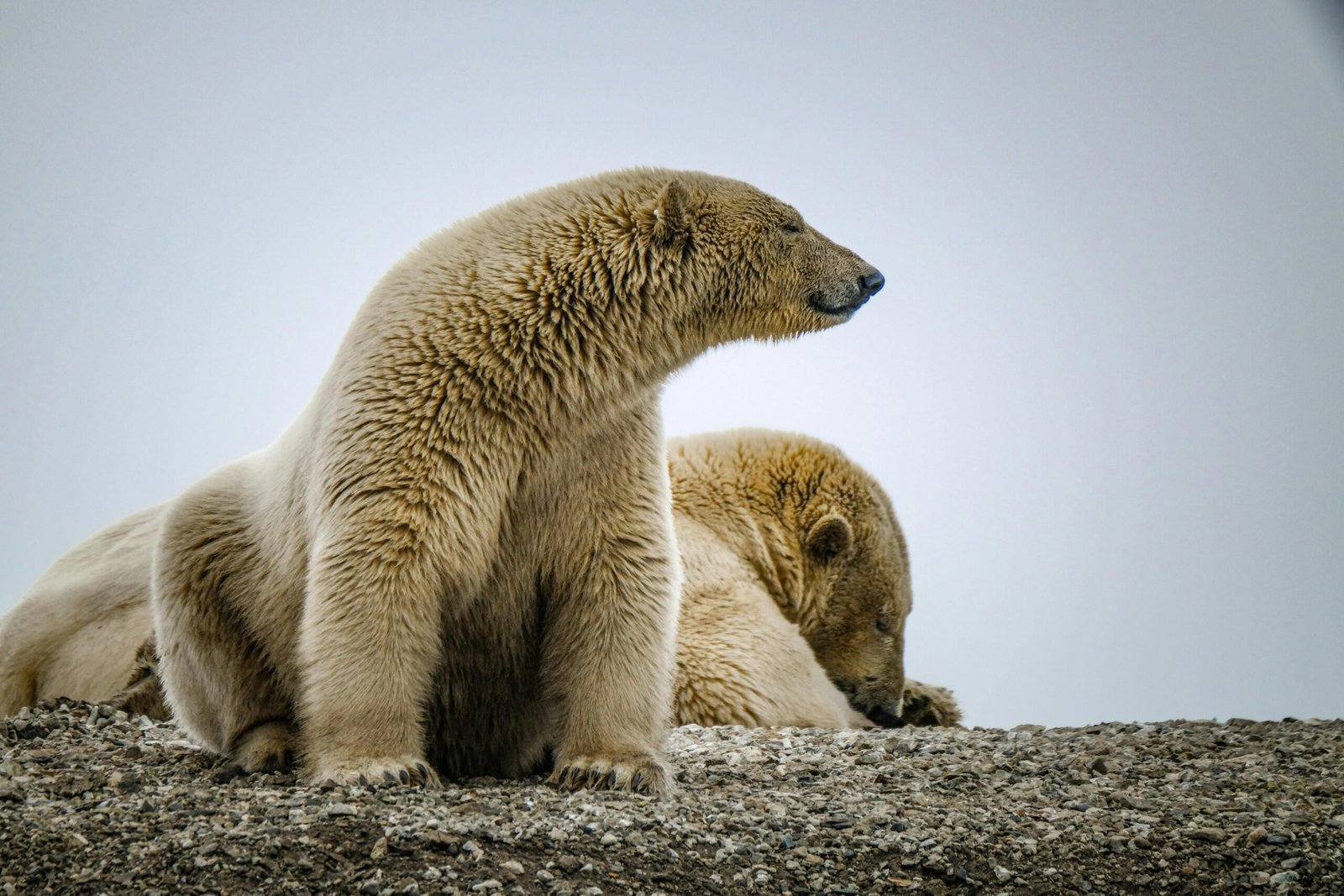
The polar bear is a specialized marine mammal closely related to the brown bear, capable of producing fertile offspring through cross-breeding. It is one of the world’s largest land-based carnivores, with a streamlined body specifically adapted for an aquatic lifestyle in the Arctic.
Location
- Distribution: this species is circumpolar in the Northern Hemisphere, spanning Eurasia and North America.
- Range Limits: it has been recorded as far north as 88°N and as far south as Iceland, Newfoundland, and the southern tip of Greenland. Permanent populations also exist in James Bay and southern Hudson Bay.
- Habitat: they inhabit the shores, islands, and pack ice of the Arctic Ocean. While mature males may spend years out on the ice, pregnant females typically come ashore to den on steep mountain slopes.
Description
- Size: males stand 4 to 4.5 feet at the shoulder and weigh between 800–1,000 pounds, though some weigh considerably more. Females are roughly 25% smaller.
- Physical Features: the bear has a longer neck than other species, a relatively small head, massive legs, and large feet with hairy soles.
- Coat: their yellowish-white fur provides camouflage in snowy environments and helps conserve body heat.
- Anatomy: the eyes, nose, lips, and toenails are black. They possess a chromosome count of 74.
Remarks
- Behavior: primarily solitary, polar bears are the most carnivorous of all bears, preying mainly on ringed and bearded seals. They are excellent travelers and swimmers, sometimes observed 40 miles from land or ice.
- Senses: they have an excellent sense of smell and good hearing, though they are often unalarmed by noise due to the constant grinding of the icepack.
- Hunting History: historically, bears were hunted using light aircraft in Alaska until 1972. Current hunting in North America is limited to Canada, utilizing Inuit guides and dogsleds under strict quotas.
- Conservation Status: the world population is estimated at 20,000 and is considered stable or increasing in some areas. However, it is listed as vulnerable by the IUCN and on Appendix II of CITES.
- Legal Status: since the 1973 Agreement for the Conservation of Polar Bears, hunting is restricted across the five arctic nations.