
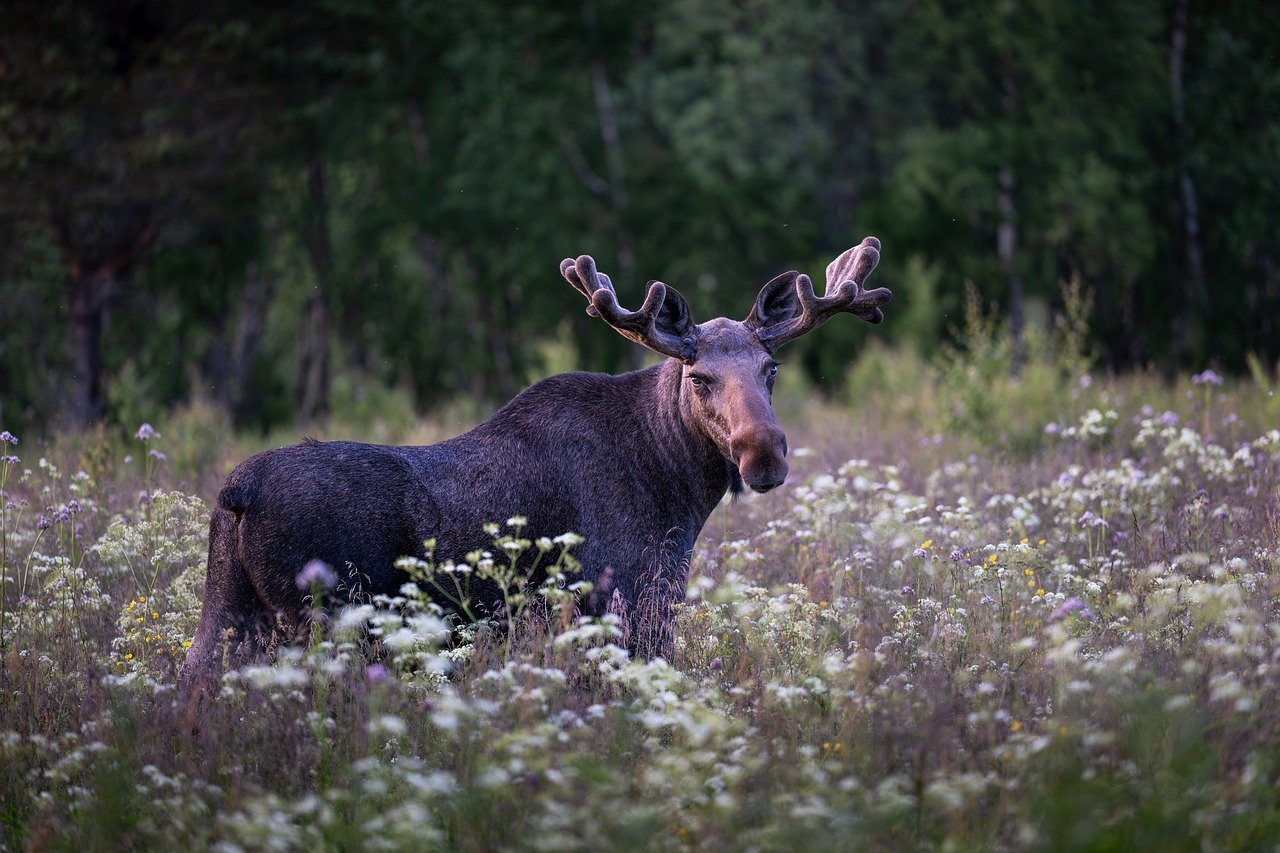
The European moose differs from Siberian and North American forms by its lighter coat, shorter nose, and distinct internal nasal and chromosomal structures.
Location
- Primary Distribution: Found across Norway, Sweden, Finland, the Baltic countries, eastern Poland, and Belarus.
- Russia: Widely distributed west of the Ural Mountains, primarily between latitudes 63°–57°N.
- Asia: The range extends into western Asia from the Ural Mountains to the Yenisei River.
- Habitat: Originally native to northern coniferous (taiga) forests; it favors mixed forests and open ground near lakes and rivers.
Description
- Size: Males stand 60–75 inches at the shoulder and weigh approximately 1,100 pounds. Females are smaller.
- Physical Appearance: Characterized by very long legs, a large shoulder hump, a short neck, and a large head with a broad muzzle. A growth of skin and hair, known as the “bell,” hangs from the throat.
- Coat: The hair is coarse and brittle, typically a uniform brown that shows little seasonal change. The lower legs are generally whitish.
- Antlers: There are two types—palmate (flattened) and cervine (branched).
- Genetics: The European moose has 68 chromosomes, whereas eastern Asian and North American subspecies have 70.
Remarks
- Behavior: Primarily solitary and active by day, with peaks at twilight. They are excellent swimmers and can submerge completely to feed on aquatic vegetation.
- Diet: Mainly a browser of deciduous trees like willows, but also grazes and eats conifer shoots or bark during winter.
- Domestication: In Russia, moose have been domesticated for meat and milk production, as well as for use as farm draft animals.
- Management: The population in Europe and Asia exceeds one million. In Sweden alone, the annual harvest is over 150,000 animals.
- Hunting & Scoring: SCI requires Method 25P (for palmate antlers) when measuring European moose for the Record Book; cervine-style measurements are no longer accepted.