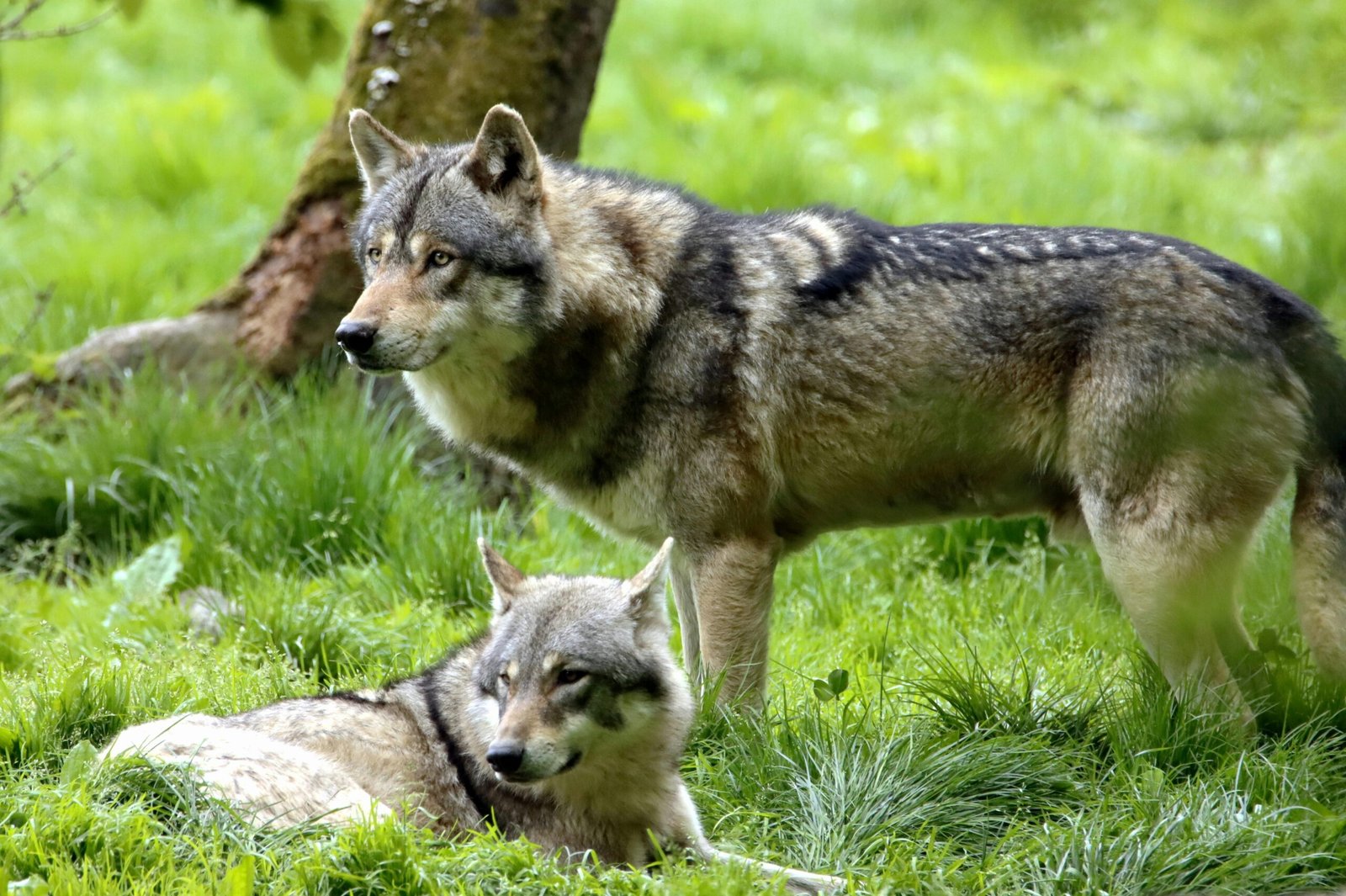
The gray wolf, also known as the common wolf, is the largest wild member of the dog family and the direct ancestor of the domestic dog. The name “gray wolf” specifically distinguishes it from North America’s red wolf and South America’s maned wolf.
Location
- Historical Range: Formerly found throughout the majority of Europe, including the British Isles.
- Current European Distribution: Primarily located in Russia, Romania, and the former Yugoslavia. Smaller populations persist in Finland, Poland, the Czech Republic, Slovakia, Bulgaria, Greece, Italy, Spain, and Portugal. A few individuals survive in northern Sweden and Norway.
- Global Range: Outside of Europe, the species is native to Asia and North America.
- Habitat: They inhabit a variety of environments, including dense forests, open woodlands, and tundra.
Description
- Size: Males typically stand 26–32 inches at the shoulder and weigh 80–120 pounds, though some weigh considerably more. Females are roughly 20% smaller than males.
- Build: Possesses a heavy frame with long legs, large feet, and a thick, bushy tail, similar in appearance to a large German shepherd.
- Skull & Teeth: Features a large skull with powerful jaws and 42 specialized meat-eating teeth.
- Coat: The fur is moderately long and thick, varying in color from grayish-brown to yellowish-brown, sometimes with a reddish tinge on the head and shoulders.
- Regional Variation: Northern wolves are generally larger with gray, long hair, while southern wolves tend to be smaller with brown, shorter hair.
Remarks
- Behavior & Hunting: Wolves are highly intelligent and wary, making them difficult to hunt. Most are taken through chance encounters, though they are occasionally hunted over bear bait or during drives for other species.
- Temperament: European wolves are reputed to be more aggressive toward humans than their North American counterparts.
- Taxonomy: While dozens of subspecies have been described based on size and color (such as C. l. lupus, C. l. italicus, and C. l. signatus), they are often grouped together for general classification purposes.