The name “Fallow” stems from the Old English fealu, referring to its characteristic light yellowish-brown color. It is often called the “common fallow deer” to distinguish it from the endangered Persian fallow deer.
Location
- Native Range: Thought to have originated in the Mediterranean region (southern Europe, Rhodes, and Anatolia/Asian Turkey).
- European Distribution: Now found throughout most of Europe. They were introduced (or reintroduced) across the continent by the Romans or Phoenicians and are frequently kept in deer parks.
- Global Distribution: Highly adaptable, they have been introduced to North and South America, New Zealand, Australia, and South Africa. They currently exist in the wild in 38 countries across six continents.
- Habitat: Primarily inhabit open woodlands, though they are hardy enough to survive in various environments as long as some forest cover is available.
Description
- Size: Males stand 36–43 inches at the shoulder and weigh 140–220 pounds. Females are smaller.
- Color Variations: This species exhibits more color variety than any other deer. The four main types are:
- Typical: Rich brown with white spots (summer); dark gray-brown (winter).
- Menil: Pale fawn with prominent white spots.
- White: True white, though not albino.
- Black: Actually a very dark brown.
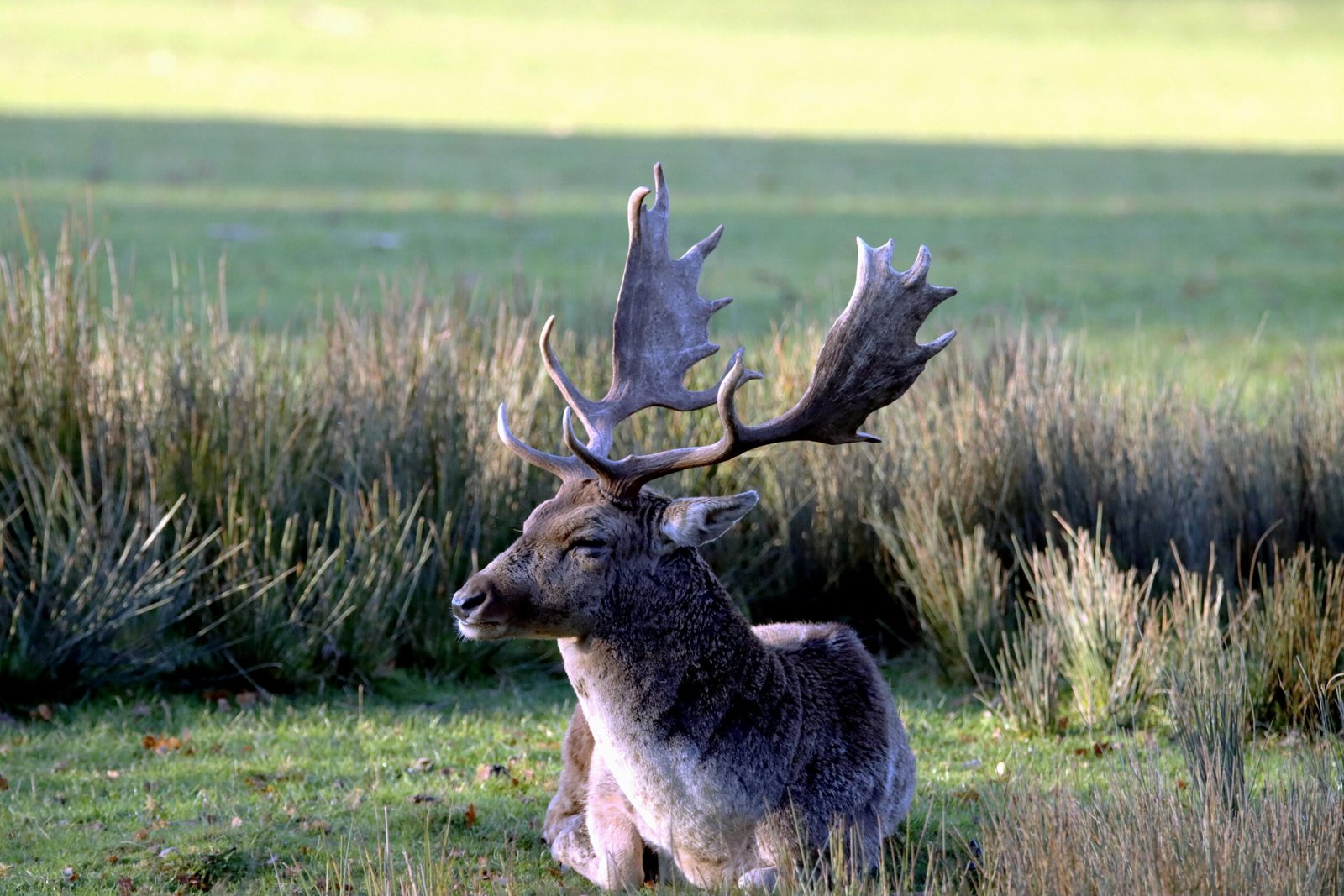
- Antlers: Distinctive for being well-palmated (flattened) at the top. They typically feature brow and trez tines (bez tines are usually absent), with several smaller tines protruding from the rear edge of the palmation.
Remarks
- Behavior: Their social structure varies from solitary to gregarious herds of up to 30. During the October rut, males become vocal—bellowing and grunting—and fight fiercely to establish territories and gather harems.
- Alertness: When alarmed, they emit a short “bark” and flee using stiff-legged bounces. While hardy, they are less wary than other deer and can be semi-domesticated with supplemental feeding.
- Diet: Primarily a grazer, but they will browse on shrubs and trees. They are mostly diurnal, with peak activity in the morning and evening.
- Hunting: The highest quality trophies are generally found in Denmark and Hungary, as well as Spain and Eastern Europe. Hunters typically seek them shortly after they strip their velvet, as the palmated antlers are prone to breaking during rutting battles.