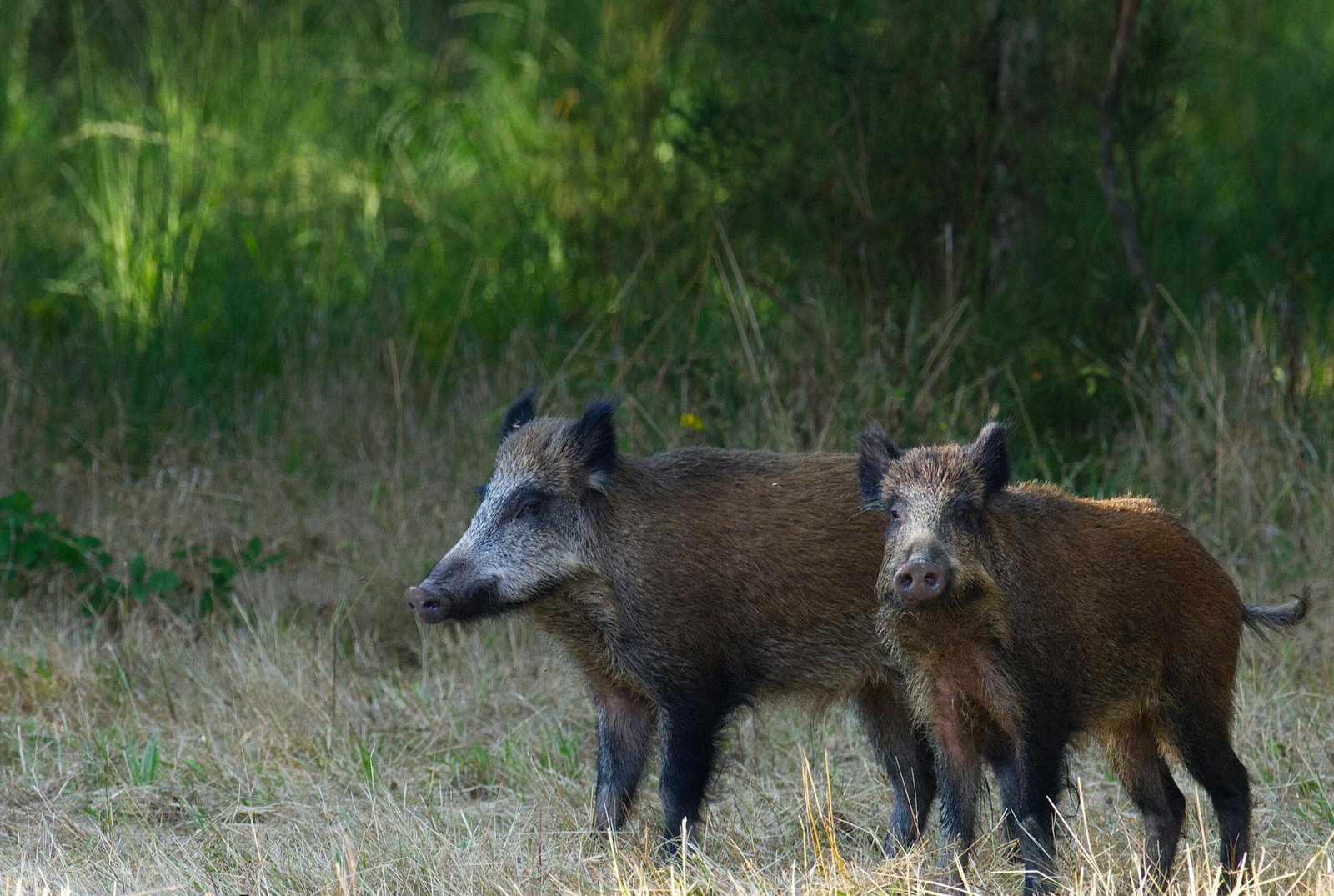
The Eurasian wild boar is a powerful, highly adaptable mammal and a premier game animal throughout Europe. It is known for its intelligence, sharp senses, and formidable tusks.
Location
- European Range: found across most of continental Europe, though it is absent from the British Isles and Iceland.
- Introduced Regions: while not historically native to Scandinavia, free-ranging populations have been introduced to southern Norway and Sweden. For record-keeping purposes, all European populations are categorized under a single indigenous group.
- Global Range: native outside Europe to northern Africa, mainland Asia (south of 48°N latitude), and several major Asian islands including Taiwan, Sumatra, and Japan. It has also been widely introduced worldwide.
- Habitat: primarily inhabits woodlands and agricultural areas with dense nearby cover. They adapt well to any altitude but strictly require access to water for drinking and wallowing.
Description
- Size: males stand 30–47 inches (76–119 cm) at the shoulder and typically weigh 150–400 pounds (68–181 kg), though exceptional specimens can reach up to 700 pounds (317 kg). Females are smaller.
- Build: medium-sized with a thick body, relatively thin legs, a short neck, and a long, pointed head terminating in a flat, disk-like snout.
- Coat: composed of dense, bristly brownish-gray hair. Some individuals display a distinct neck mane and cheek whiskers. They lack facial warts.
- Anatomy: each foot features four toes, with the middle two supporting the body and the two lateral toes (false hooves) sitting higher up. The stomach is two-chambered and non-ruminating.
- Tusks: canine teeth are highly developed into tusks in males (females have much smaller tusks). The upper tusks curve outward and backward, while the lower tusks curve upward and backward. These teeth constantly grind against each other, honing incredibly sharp edges.
Remarks
- Behavior: highly gregarious, typically traveling in family groups (sounders), though old boars tend to be solitary. They are naturally active during the morning and afternoon but will quickly become completely nocturnal if harassed by human activity.
- Diet & Senses: omnivorous animals that consume all types of vegetation, small animals, and carrion. They possess an excellent sense of smell, good hearing, and only fair eyesight.
- Athletic Traits: despite their heavy build, wild boars are fast runners and remarkably strong swimmers.
- Taxonomy: although various authorities list up to seven distinct regional European subspecies (such as scrofa, attila, majori, and castilianus), they are not separated for general record-keeping purposes.
- Hunting: recognized as an excellent game animal due to being highly alert, wary, and quite dangerous at close quarters when cornered or wounded.