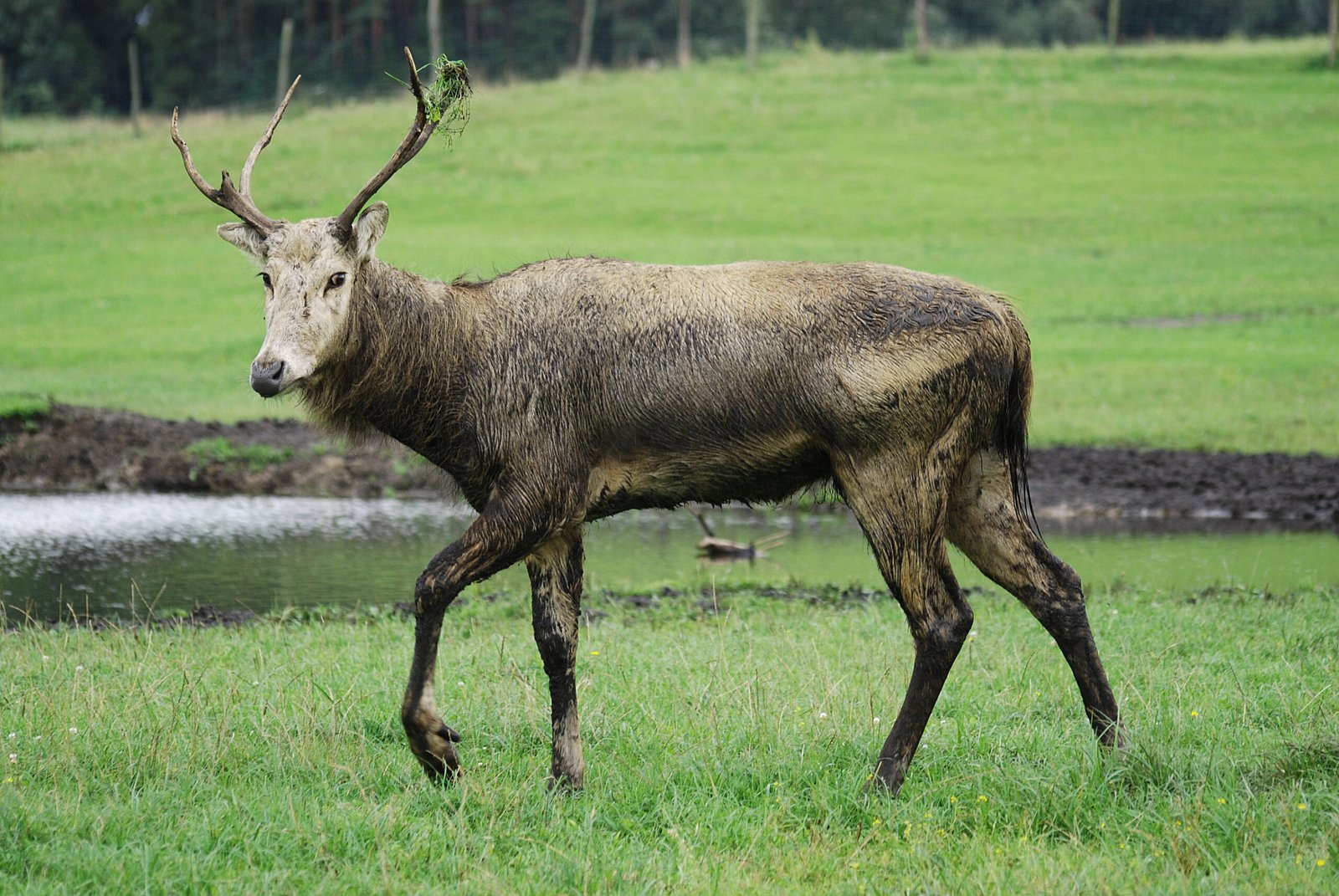
Named after the french missionary Père Armand David, this deer is known in China as the mi-lu or ssu-pu-hsiang (the “four unlikes”), because it is said to have the tail of an ass, the hooves of a cow, the neck of a camel, and the antlers of a stag.
Location
- Current Distribution: found on private properties and estates throughout England and continental Europe.
- Global Range: they have been introduced to the United States and Argentina, and successfully reintroduced to their native China.
- Habitat: while currently only known in captivity, they were originally adapted to swamps and reedy marshes.
Description
- Size: males stand 45–47 inches (114–119 cm) at the shoulder and weigh 330–440 pounds (150–200 kg). Females are smaller.
- Distinctive Features: a large deer with a notably long tail, a mane on the neck and throat, and large, spreading hooves similar to those of a caribou.
- Coat: the summer coat is reddish with a dark dorsal stripe, transitioning to an iron-gray in the winter.
- Antlers: the antlers are highly unusual; the main beam rises straight up from the forehead with a long tine pointing backward. Despite lacking forward-pointing tines, males use these large structures effectively for fighting.
Remarks
- Conservation History: extinct in the wild for nearly 2,000 years, the species survived in the Imperial Hunting Park near Beijing. After the population there was destroyed by flood and war at the turn of the 20th century, the species was saved from total extinction by the Duke of Bedford at Woburn Abbey, England. By the end of WWI, only 50 individuals remained in the world—all at Woburn.
- Behavior: primarily grazers that eat aquatic plants in summer. During the June rut, males engage in unique combat, which includes using their antlers and teeth, as well as rising on their hind legs to “box” with their front hooves.
- Management: because they exist primarily in managed collections rather than the wild, surplus animals are harvested to manage population density. The trophy fees from these harvests are essential for funding the high costs of protecting and feeding these rare animals.