
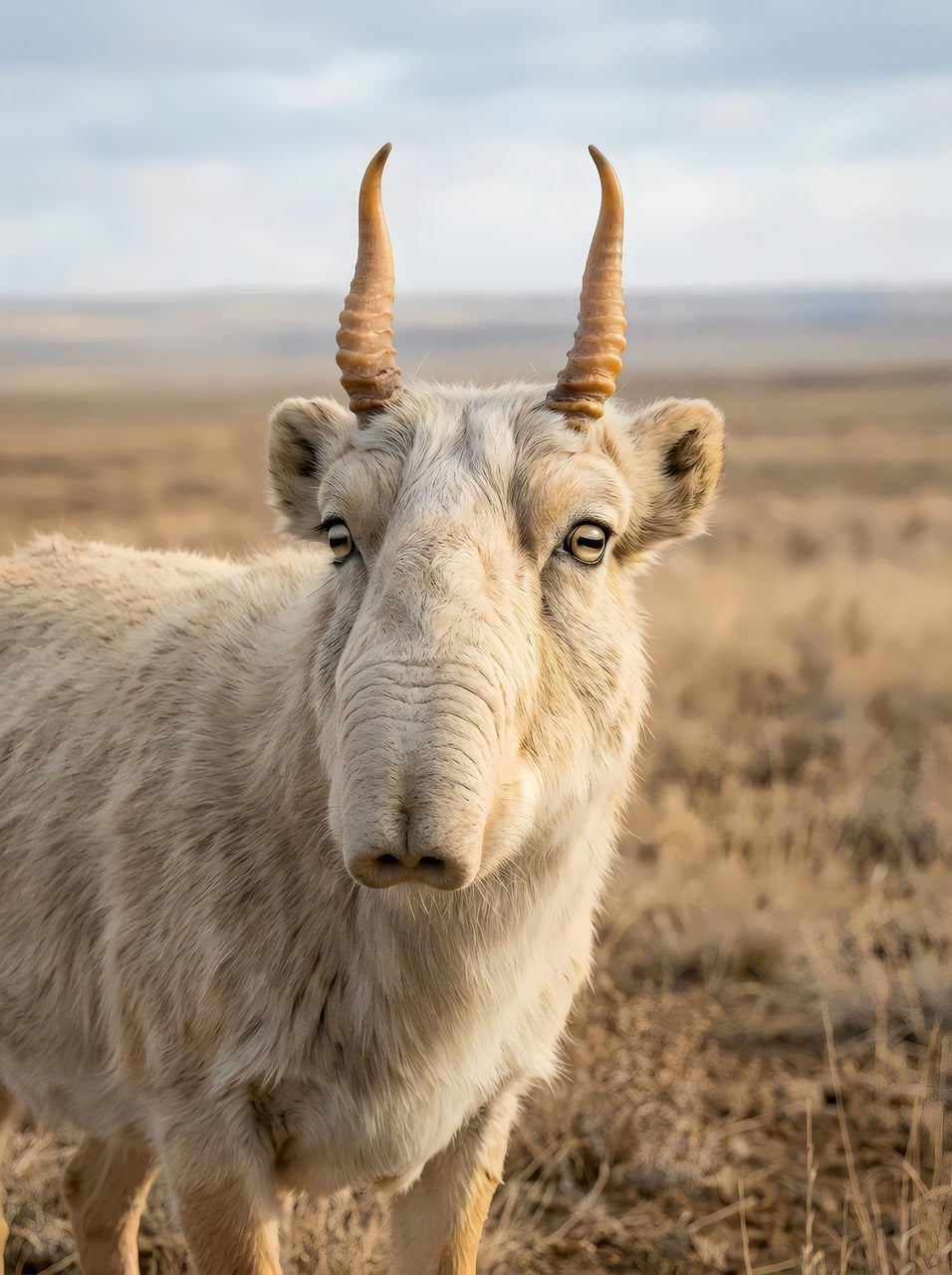
The saiga is a uniquely structured antelope easily recognized by its remarkable, swollen snout. This proboscis-like nose contains downward-pointing nostrils and a complex internal bone structure lined with mucous membranes—a feature shared only with whales—which is thought to warm and moisten cold, dusty air before it reaches the lungs.
Location
- European Range: its distribution within Europe is strictly limited to the Kalmyk Republic in the southeastern region of the Russian Federation, as well as adjacent areas of western Kazakhstan west of the Ural River.
- Introduced Range: they have been introduced to the islands of Bulla and Glinyany in the Caspian Sea.
- Global Range: beyond the European border, the species extends through Asia from the Ural River eastward into northern Xinjiang, China.
- Habitat: they primarily inhabit grassy plains and semi-deserts, though they may occasionally enter open forests during the summer months.
Description
- Size: males stand 30–31 inches (76–79 cm) at the shoulder and weigh 90–100 pounds (41–45 kg). Females are somewhat smaller.
- Build: the animal has a somewhat heavy, short build relative to its length. It naturally carries its head low with its neck extended forward.
- Coat: * Summer: a cinnamon-tan coat with a white rump, tail, and underparts.
- Winter: transitions to a heavy, uniformly whitish coat to endure colder climates.
- Horns: only males grow horns. These are short, ringed, slightly lyrate (u-shaped), and a pale amber color that becomes almost translucent at the tips.
Remarks
- Anatomical Adaptation: the saiga’s large, flexible nose structure is one of the most specialized respiratory adaptations found in land mammals, crucial for surviving the extreme temperature swings and dust of the Eurasian steppe.
- Postural Identity: their low-slung head posture gives them a distinct profile when moving across the plains.